Entering the Turkish Crypto Market: A Field Guide for Web3 Teams
Why global protocols keep burning budget in one of the world’s largest crypto markets, and what works instead. Written from Istanbul, after four years of doing it.
The short version. Turkey processed close to $200 billion in crypto transactions in the year to mid-2025, roughly four times the UAE. Retail activity is shrinking, institutions drive most of the volume, and the speculation-heavy profile means headline numbers tell you very little about whether your product will find users. The funnel here starts on a licensed exchange and breaks at self-custody. Trust is the scarce resource, and nothing works without a credible local voice in front of it.
Turkey is one of the biggest crypto markets on earth and one of the easiest to waste money in.
Chainalysis ranked it 14th globally for adoption in 2025 and first in the Middle East and North Africa, with close to $200 billion in transaction volume. The UAE, in second place regionally, did $53 billion. That gap is not a rounding error.
Look underneath the headline and the picture gets more interesting. Retail transactions actually contracted over the same period, small ones by 1.6% and larger ones by 2.3%. Growth among professional traders fell from over 40% year on year to about 4%. Institutional flows now make up most of the activity. Chainalysis reads the market as speculation-led rather than adoption-led, and the composition data supports that.
So the country that looks like a goldmine on a volume chart is, up close, a market where ordinary users are pulling back and big players are doing the trading. That distinction matters enormously if your plan was to acquire retail users with a campaign.
Most teams never get that far. They arrive with a translated landing page, an airdrop, a KOL package bought through an agency, and a Telegram group that dies within two months. Then they decide Turkey is full of mercenary users and move on. The market was never the problem.
From Istanbul, I do partnerships for a global Web3 security company, advise teams like Zama on entering this market, and co-founded the research hub Pharus. This is what I wish every team knew before spending their first dollar here.
Who actually uses crypto in Turkey?
“Crypto Turkey” is two populations, and a strategy that treats them as one will fail twice.
The traders. Enormous, liquid, exchange-native, comfortable with leverage. Most are here for one reason: they think crypto is easy money. That is not a sneer, it is the operating assumption you should plan around, and it predicts their behavior better than any persona document. They live on Binance TR, BTCTurk and Paribu, trade daily, and would not describe themselves as DeFi users.
You can watch the mindset in the data. Through late 2024 and into 2025, stablecoin trading volume in Turkey fell sharply while altcoin volume climbed past it and kept climbing. When the market looks interesting, money here leaves dollars for whatever might move.

The DeFi users. Far smaller, self-custody, already onchain, and the pool every future power user comes from. They arrived for something specific: dollar exposure a Turkish bank account cannot provide, access to products the local system does not offer, or genuine interest in the technology.
Most products can serve both, never with the same message. Traders respond to depth, execution and cost. DeFi users respond to access and control. Write one line for “Turkish users” and it will sound vague to everybody.
Perp DEXs show how thin the wall between these groups really is. Turkish traders took to onchain perps quickly, because the product speaks a language they already know: leverage, execution, familiar screens. Watch what people actually do and you find a split stack, with fiat and spot on BtcTurk or Paribu and derivatives on a global venue. They move between the regulated layer and everything else without treating it as an ideological choice. A trader who learns to hold a position onchain has quietly done most of the work of becoming a DeFi user, without ever using the phrase.
My own case is the clearest illustration I have. Turkish residents cannot take foreign currency cash loans, whether the lender is local or foreign. In 2023 I borrowed stablecoins against my ETH on Aave and bought a car with them. To a trader that is leverage. To a DeFi user it is credit their bank is legally barred from selling them. Same transaction, two entirely different reasons to care.
Why does the funnel break before your product?
Even DeFi starts on an exchange. Almost nobody in Turkey arrives onchain directly. The path runs from lira into a local exchange, into USDT, and then, for a small minority, out to self-custody, usually over Tron because TRC-20 is what the exchanges made cheap and default for withdrawals years ago.
The real funnel is longer than the one in your deck:
lira → licensed exchange → stablecoin → withdrawal to a wallet → gas token → first protocol interaction

Every strategy I have watched fail here failed at step four or five, never at the top. Users had money, interest, even an account. What stopped them was choosing a wallet, choosing a chain, discovering they needed a separate token for gas, and not understanding the risk well enough to feel safe. Ad campaigns do nothing for that. Documentation, walkthroughs and patient people do.
Some of it is a product problem you can solve. Support the chain your users already withdraw to rather than the one you wish they used. Keep first transactions cheap enough that a mistake does not hurt. Remove the gas token step through sponsorship or paymaster-style abstraction if your stack allows it. Every step you delete is worth more here than a month of paid reach.
If your activation metric starts at “connects wallet,” you have skipped the part of the funnel where Turkey actually lives.
One more thing every funnel here needs: a person at the front of it. Not a campaign, a person. Someone the crowd already follows, who walks the steps publicly and answers basic questions without making anyone feel stupid. Phaver is the clearest case I have seen. A large share of its Turkish user base came through Efe Bulduk, who did not simply endorse the product but led people through it, showing exactly what to click while thousands followed. Documentation removes the friction. A trusted voice gets people to actually walk the path.
What do Turkish crypto users expect?
They expect a smooth experience. The local exchange apps are genuinely good: fast onboarding, clean interfaces, all in Turkish. That is the bar you are measured against. A clunky English-only dApp does not read as early, it reads as unfinished.
They respond to rewards. Points, tiers, referrals, cashback and competitions all work here, and there is no reason to be snobbish about it. Local platforms trained this market to expect a program, and its absence is conspicuous.
And they will not trust you. Global teams underestimate this constantly. This market lived through Thodex, whose founder fled the country with users’ funds and later received a prison sentence measured in thousands of years, plus a long tail of smaller collapses. What looks like cynicism from outside is scar tissue. You will not argue your way past it. You get past it by being visible, useful, and still around a year later.
How does Turkish crypto regulation affect market entry?
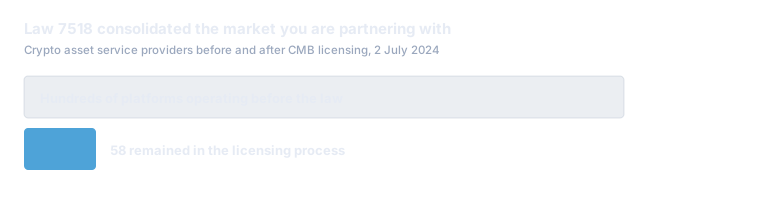
The 2021 payments ban is the rule everyone quotes and rarely the one that constrains you. What shapes distribution now is Law 7518, in force since 2 July 2024, which brought crypto asset service providers under Capital Markets Board licensing with MASAK anti-money-laundering obligations attached. The consolidation was severe. Hundreds of platforms had been operating; 58 remained in the licensing process afterward.
The asymmetry is worth understanding. Moving lira into crypto runs through the regulated layer, with the partnership timing and compliance friction that implies. What a user does onchain afterward does not. Scope your local partnerships to the on-ramp and build the rest of the experience for self-custody.
Does narrative marketing work in Turkey?
Turkish crypto users love a story. Tokens with a narrative move. Tokens without one do not, however good the technology is.
A narrative only exists once someone credible tells it. Written on your own blog, it is positioning. Spoken by a person this market trusts, in their own words, it becomes something people repeat. That person needs three qualities at once: trustworthy, genuinely expert, and good at communicating. Missing any one makes the endorsement worse than useless.
Which brings up KOL marketing, where most budgets in this country go to die. The standard package buys copy-pasted threads, engagement from bot networks, and audiences assembled specifically to be sold to. It produces screenshots for your report and nothing else.
Work with a small number of people and make sure they are professionals. Remember too that every type of user has its own hero. The trader who moves the futures crowd has no pull with developers. The researcher DeFi natives read has no reach into retail. The university club leader speaks to people neither of the others can find. Match the voice to the segment instead of buying the biggest follower count on offer.
Which users should you target first?
Start with the smallest, hardest audience and work outward: power users, then developers, then everyone else.
Power users are few and brutally critical, and they set the terms. Win them and they defend you unprompted, because their own reputation now includes you. Developers follow, since builders treat a protocol as infrastructure once the serious people are using it. Retail arrives last, after both groups have vouched, because retail here learned to wait and see who is still standing.
Run it in reverse, mass campaign first, and you get a bump in wallet count with nothing underneath.
How long does it take to build a presence in Turkey?
Longer than your quarterly plan allows. Roots here come from talking to a lot of people, one conversation at a time. Nearly every partnership I have closed in four years started with a cold message and a slow conversation.
There is no shortcut, and the teams that keep hunting for one keep paying agencies to hunt on their behalf.
What should the first 90 days look like?
Map the ecosystem before you touch a campaign. Which venues matter, which educators survived the last cycle, which university blockchain clubs are active (METU, ITU and Boğaziçi all have real ones, and the questions there are sharper than at most industry conferences), and which local fintechs are already experimenting onchain.
Document your own funnel in Turkish, end to end, from lira on an exchange to a first transaction in your product, including the boring steps. Without that, nothing else converts.
Choose one niche, almost always power users, and go earn it in person. Meet the few credible voices for that segment and let them test the product before you ask for anything.
Then use those same power users as your fact-checking layer. This is the highest-return thing you will do all quarter. Plenty of people, institutions and exchanges here look excellent on paper: impressive follower counts, published volumes, a polished deck, a name you half recognize. A significant number are not what the numbers suggest. Your only reliable filter is a handful of experienced locals who will tell you privately which relationships are real, and they will only tell you once they trust you. Run every prospective partner past them before you sign.
Then, after all of that, spend on reach. By that point you will usually find the campaign you originally planned is not the thing that moves the number.
Turkey never needed persuading to care about crypto. Inflation and a decade of financial instability handled that long before any of us arrived. What this market is still waiting for is teams that treat it as a place to build something durable and stay long enough to be believed.
More from Pharus. We publish research on the Turkish and global crypto markets, including reports on Ethereum digital-asset treasuries and institutional flows. Read our latest research or follow along here for market-entry breakdowns and data on Turkish crypto adoption.
Sources: Chainalysis 2025 Global Crypto Adoption Index and 2025 Geography of Cryptocurrency Report (Turkey ranking, MENA volumes, retail and institutional composition, stablecoin and altcoin volume trends); Law No. 7518 amending the Capital Markets Law, in force 2 July 2024, with CMB communiqués III-35/B.1 and III-35/B.2 (CASP licensing and platform consolidation); Turkish FX legislation restricting foreign currency cash loans to individuals.
Atakan Yavuzarslan leads partnerships at GoPlus Security and co-founded Pharus, Turkey’s first Web3 research hub. He has advised global protocols on Turkish market entry since 2023.